
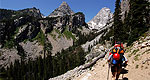




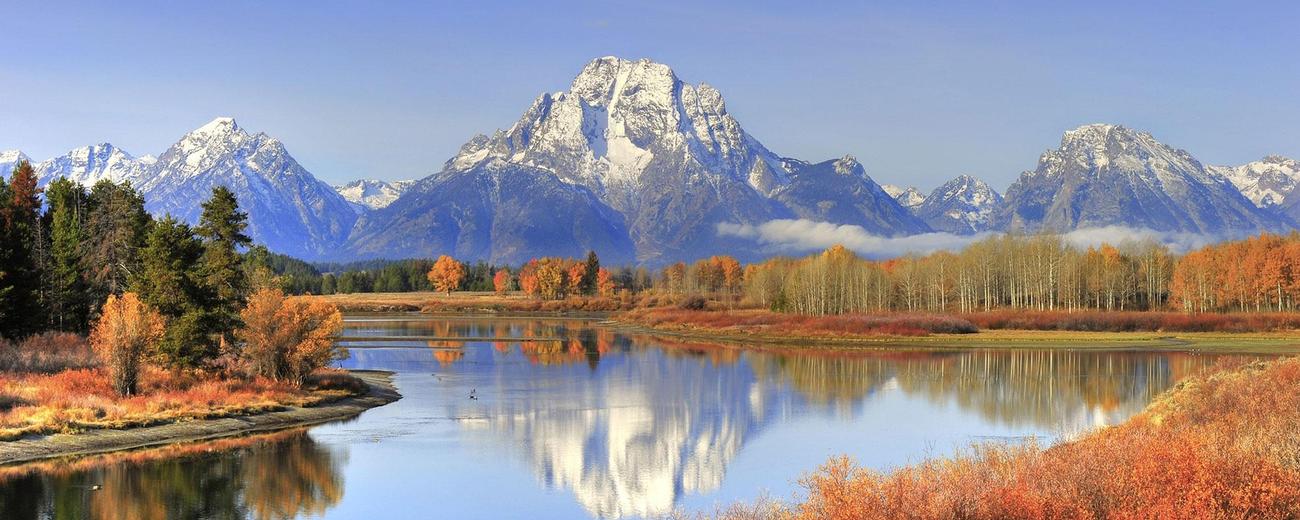



Grand Teton National Park is one of the most iconic natural places in the entire United States, its peaks inspiring countless works of art and drawing over a million visitors per year. The Teton Range of Wyoming, the youngest and perhaps the most dramatic stand of mountains in the entire Rocky Mountains, juts straight out of the Jackson Hole Valley, rises over 7000 feet and tops out at an impressive 13772 atop the Grand Teton. Elk, moose, pronghorn, mule deer, and bison are commonly seen in the park. Black bears are common in forested areas, while grizzlies are occasionally observed in the northern part of the park. More than 300 species of birds can be observed in the park, including bald and golden eagles and peregrine falcons.
Grand Teton National Park, the southern half founded in 1929 and the northern half added in 1950, was almost lost to ranching interests and was preserved only through a two decade effort by a politically charged grass-roots local effort. This effort, backed by the Rockefellers, bought up small parcels of land, combining them into larger parcels and then eventually donatated them to the National Park Service. As a result, Grand Teton National Park gives any visitor who enters its borders a feeling for what this area was like prior to the massive development that has taken place in the surrounding areas during the past century. Teton National Park is a land full of life, with rolling grasslands cut by meandering mountain streams and dotted by stands of winding scrub oaks and glacially carved lakes, the valley eventually giving way to rugged mountains that scrape the sky with their jagged peaks; Grand Teton National Park will long linger in the memories of all who visit her.